How Arismeta Modernized Metamorfs’ B2B E-Commerce Platform

Executive Summary
Metamorfs is a global telecom and IT infrastructure business spanning technology services, telecom lifecycle solutions, supply chain and logistics, enterprise platforms, data and AI, consulting, and talent solutions. Its digital platform needed to support a broad service portfolio alongside a complex B2B commerce environment.
Arismeta worked across the digital experience and underlying platform architecture to modernize the customer journey, strengthen commerce workflows, improve international shipping reliability, and restore operational capabilities that were present in the platform but not fully enabled.
The engagement resulted in a more coherent digital commerce experience with live carrier-quoted shipping, stronger checkout integrity, persistent cart and shipping selections, functional administrative workflows, and improved customer self-service.
From a Legacy Service Structure to a Unified Digital Experience
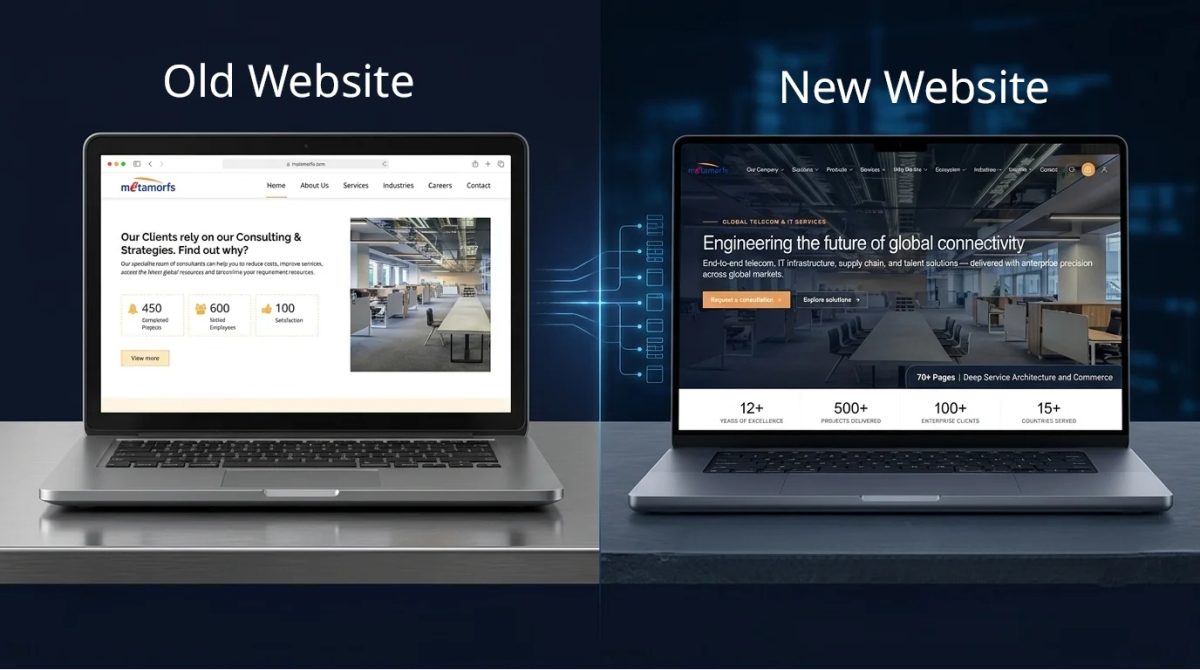
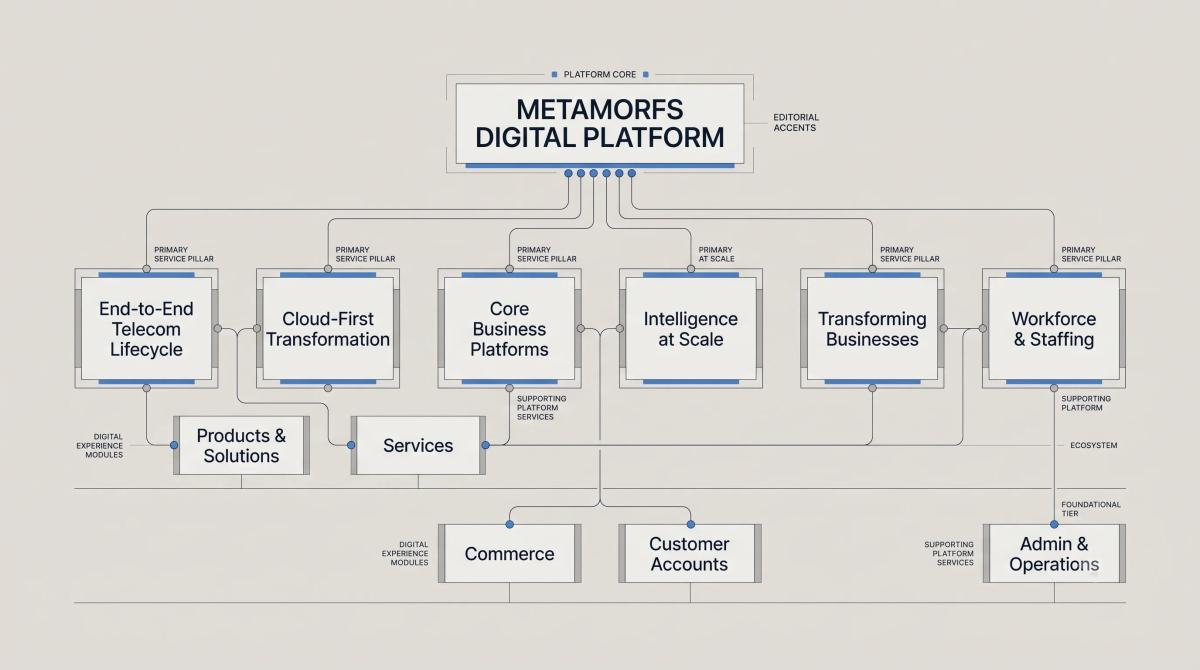
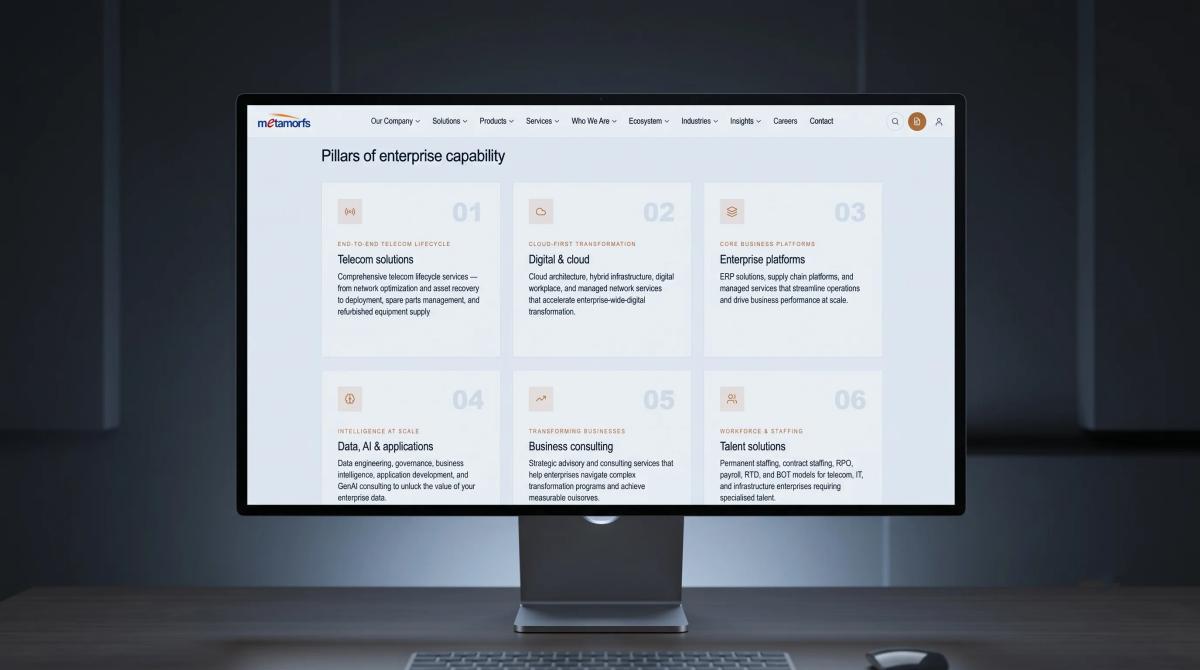
The legacy Metamorfs website presented the business through broad service categories including IT services, Telecom Services & Solutions, Warehouse / Logistic Services, Repair Services, Staffing Solutions & Services, and Business Consulting. The current experience organizes the proposition into clearer enterprise capability pillars, including End-to-End Telecom Lifecycle, Cloud-First Transformation, Core Business Platforms, Intelligence at Scale, Transforming Businesses, and Workforce & Staffing.
This evolution gave the digital experience a more structured way to communicate a much broader enterprise offering while supporting the commerce and operational workflows underneath it.
The Challenge
Metamorfs needed a digital platform capable of representing a broad enterprise offering while supporting a complex B2B commerce operation. The challenge extended beyond front-end presentation: shipping, checkout, customer accounts and internal administration all had to operate reliably.
The scale of the rebuild was itself a significant part of the challenge. The legacy Metamorfs website was a lean, largely static site of around 9 pages, whereas the platform Arismeta has developed now spans 70+ pages across products, services, commerce workflows, customer accounts and administrative tooling, nearly an eightfold increase in footprint that had to be planned, structured and maintained without fragmenting the experience.
- Grow the website from a 9-page legacy structure to a 70+ page platform while keeping navigation, design and content coherent.
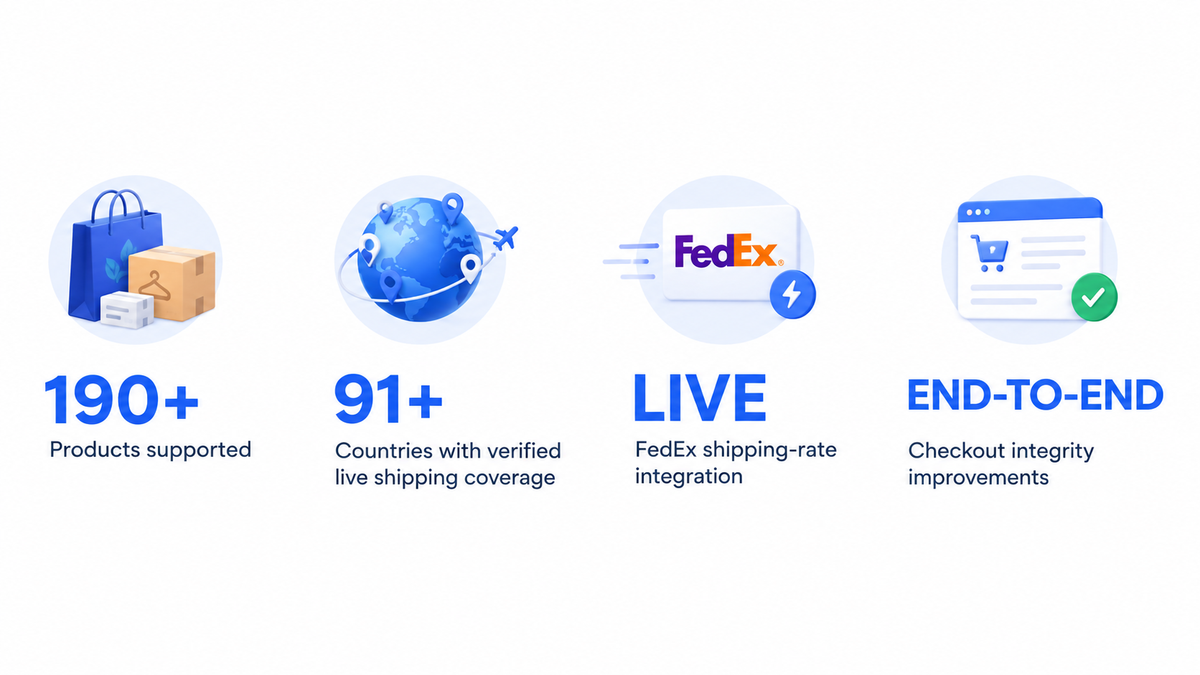
- Support a 190+ item product catalog and B2B purchase / request-for-quote workflows.
- Provide accurate international shipping rates rather than relying on static estimates.
- Protect the integrity of shipping information recorded against orders.
- Reduce unnecessary friction during checkout.
- Restore important administrative capabilities that had been left behind in the existing codebase.
- Give customers access to order history and saved addresses.
- Provide a request-for-quote path, rather than fixed pricing, for larger and heavier enterprise hardware — a gap raised directly by the client.
- Maintain consistent navigation, branding and shared components across a much larger and more complex page inventory.
- Structure and build significantly more product, service and content pages without degrading SEO value or page performance.
- Introduce spam and abuse protection across a growing number of public-facing forms and entry points as the site's surface area expanded.
What the Engagement Set Out to Achieve
- Create a clearer and more cohesive digital experience across Metamorfs' service and commerce ecosystem.
- Strengthen the technical foundation of the B2B e-commerce platform.
- Make international shipping more accurate and transparent.
- Improve checkout continuity and reduce unnecessary data entry.
- Enable operational teams to manage key commerce functions through the admin platform.
- Improve customer self-service within account workflows.
The Arismeta Approach
1. Experience & Information Architecture
Arismeta worked on the customer-facing experience and platform structure to make a broad set of services, products and workflows easier to navigate and operate. The result is a more unified digital environment rather than a collection of disconnected capabilities.
2. Commerce Engineering
The commerce core was strengthened around live shipping, checkout integrity, state persistence and customer account functionality. Shared front-end components were used across cart, checkout and product experiences to keep key interactions consistent.
3. Operational Enablement
The administrative environment was consolidated and previously incomplete areas were restored, giving business users functional management views across products, orders, customers, discounts, quote requests, vendors, partners, content and other operational areas. A role-based permission system was also introduced, letting a superadmin provision limited-access staff accounts scoped to specific modules rather than granting full administrative control by default.
Digital Experience Across Metamorfs' Service Ecosystem
The current Metamorfs experience presents six enterprise service pillars. These pillars provide the information architecture through which visitors can understand the company's capabilities:
Engineering the Difficult Parts
Live International Shipping
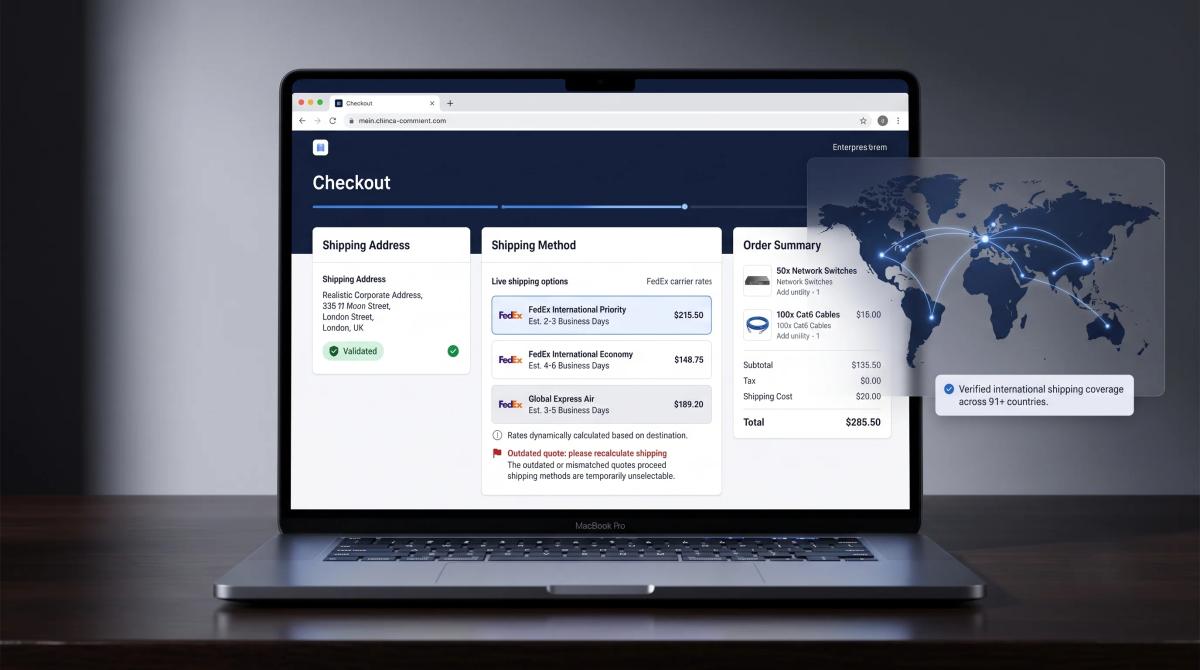
A static, hand-maintained shipping-rate table was replaced with a direct FedEx Rate & Transit Times API integration, authenticated through an OAuth2 token that is cached and refreshed automatically before it expires. The implementation accounted for country-specific address rules, unserviceable destinations and inconsistent legacy product-weight data, including mixed units and free-text values.
- Normalized free-text legacy weight data — values such as "5 kg", "0.48 kg", "8-10 kg" and "9.70lb", and occasionally non-numeric junk — by extracting the first valid number, converting kilograms to pounds, and applying a safe default per item whenever a weight could not be parsed.
- Handled FedEx's country-specific address rules, including which destinations accept a state or province code and which have no formal postal system, supplying a placeholder value only where required to satisfy the carrier's API without misrepresenting the address.
- Computed delivery estimates from FedEx's own commit dates when available, and from a typical-transit-time table per service level when they were not, so every quote shows a real expected delivery date.
- Returned multiple live, price-sorted shipping options per request rather than a single flat rate, giving customers a genuine choice of service level at checkout.
The team audited live rate coverage across the countries offered at checkout and ensured that any failure to retrieve a live rate surfaces as an explicit error message rather than a fabricated static price.
The estimator was rebuilt as a single shared component used on both the cart page and at checkout. On the cart page, shoppers enter a destination to preview rates; at checkout, it reuses the address already captured during the shipping step so it is never re-entered. It also detects when a previously applied quote no longer matches the shopper's current address and blocks it until a fresh quote is obtained, reinforcing the checkout data-integrity safeguards described below.
Checkout Data Integrity
Arismeta identified a variable-naming collision that was silently replacing recorded shipping-method information with placeholder data. The issue was corrected, and destination-verification logic was added so a changed shipping address requires a fresh quote.
- A shipping method now only counts as valid if it is verifiably quoted for the exact address being shipped to — matched against the live destination — rather than treated as valid just because some rate had been applied.
- A legacy or older saved quote with no record of what destination it was quoted for is treated as unverifiable and blocked in the same way as a mismatched one, rather than being allowed through by default.
- Checkout keeps the Shipping Method step marked incomplete and blocks order submission until a mismatched or unverifiable quote is replaced with a fresh one for the current address.
- The order total no longer folds in a shipping cost that hasn't been validated against the current destination, so a stale rate can't be silently charged against the wrong address.
- On submission, the shipping details sent to the backend are rebuilt into a minimal, known-safe object — service, rate, carrier and estimated delivery — rather than forwarding the client-side quote data as-is.
Persistent Commerce State
Cart and shipping selections were previously held only in component state, so a page refresh, a closed tab, or simply navigating away could silently reset a customer's in-progress order. Persistence was rebuilt around two mechanisms suited to how each piece of data is actually used.
- A chosen shipping rate is written to local storage the moment it's applied, and cleared automatically when the cart is cleared, so it survives a page reload or a reopened tab instead of quietly resetting.
- For logged-in customers, cart contents are persisted server-side and synced automatically on every change, so the cart carries across devices and sessions rather than just within one browser.
- A guarded loading sequence ensures the cart only starts syncing to the database after the customer's saved cart has finished loading — closing off a race condition that could otherwise let an empty initial cart silently overwrite saved items.
- Items added before logging in are merged into the account's saved cart on login rather than discarded, so a guest browsing session isn't lost the moment a customer signs in.
- Local-storage reads and writes are wrapped defensively so private-browsing or storage-restricted sessions degrade gracefully instead of breaking the cart.
Request-for-Quote for Heavy Enterprise Hardware
For larger, heavier equipment — GPU servers, x86 servers, storage arrays and workstations — a fixed catalog price and standard checkout don't reflect how this class of product is actually priced and shipped. This gap was flagged directly by the client, and Arismeta built it out into a dedicated request-for-quote pathway rather than a quick fix.
- These categories show "Contact for price" in place of a listed price, consistently across the catalog grid, list view and product detail page.
- A "Request a Quote" action sits alongside Add to Cart everywhere a product appears, feeding a separate, persistent quote cart rather than the shopping cart.
- Submitted requests flow into a dedicated Quote Requests module in the admin dashboard for the sales team to review and price manually.
The feature went through several rounds of refinement with the client after the initial build, polishing both the customer-facing flow and the admin workflow until the experience matched how the sales team actually wanted to handle these requests.
Vendor Registration and Partner Onboarding
Beyond the storefront, the client also wanted a proper system for bringing on new vendors and partners, not a simple contact form, but the same kind of structured account-application process used to formally onboard a new business relationship. This turned out to be one of the trickier pieces of the build, and it took real back-and-forth with the client to get right.
- The "Become a Partner" application is a five-step account-application wizard — company info, key contacts, address & bank reference, business profile, and a compliance agreement step — with per-step validation and formal terms, export-control and anti-money-laundering acknowledgements required before it can be submitted.
- Vendor Registration is a four-step equivalent — company, financial, compliance and technical sections — that also accepts supporting document uploads alongside the form data, submitted together as a single request.
- Uploaded vendor documents are stored in cloud storage, with each file handled independently so a failure on one attachment doesn't block the submission or the internal notification email.
- Every submission generates a fully formatted internal notification email summarizing every section of the application, alongside a structured record with a pending-to-approved review status that the admin dashboard's Vendor Registrations and Partner Applications modules manage.
Getting the validation, file handling and notification pieces to work together cleanly took several iterations, but the result is a genuine intake and review pipeline rather than a form that simply emails someone.
Restoring the Operational Layer
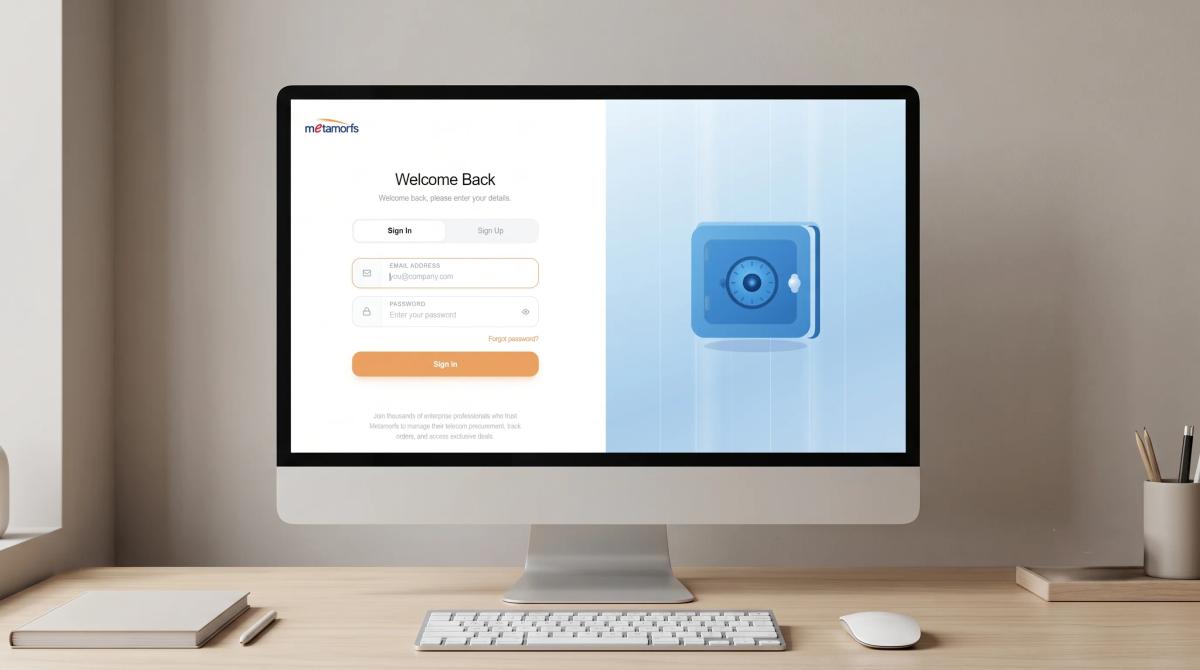
The work extended beyond the storefront. A broad set of admin modules were restored or newly enabled, giving business users functional, end-to-end management across the commerce and content operation:
- Products and Data Center Products catalogs.
- Orders, Customers and Discounts management.
- Quote Requests, Vendor Registrations and Partner Applications.
- OEM Categories.
- Content management for Blogs, Whitepapers and News & Announcements.
- Jobs and Applications management.
- Expert Queries, Consultation Requests and Contact Us inquiries.
Role-Based Staff Permissions
A dedicated Staff Management module was introduced for the superadmin role, allowing limited-access sub-admin accounts to be created, enabled or disabled, and password-reset without granting full administrative control. Staff accounts are scoped to day-to-day operational modules such as products, jobs, orders, customers, discounts and inquiries, while content publishing, vendor and partner management, and staff provisioning itself remain restricted to superadmin. Product changes are also attributed to the responsible admin or staff account, giving the business a clear audit trail.
Customer-facing My Orders and Addresses sections were also connected to account navigation.
The Transformation
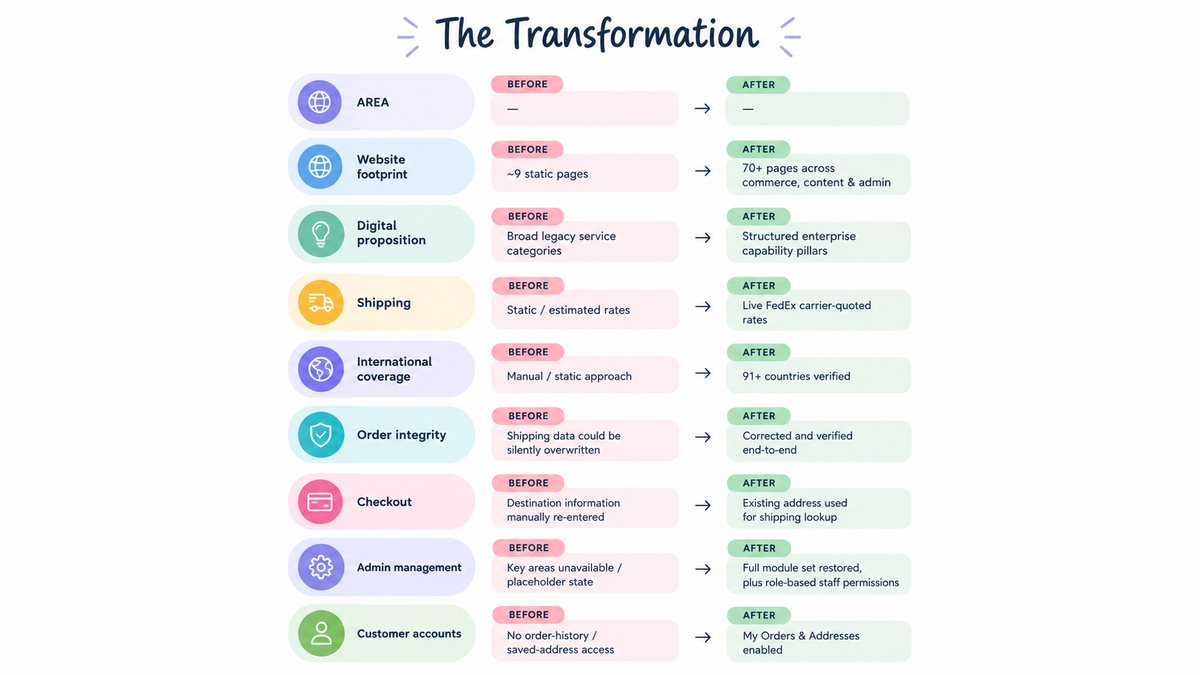
Verified Outcomes
The project delivered measurable platform improvements that can be evidenced directly from the engineering work.
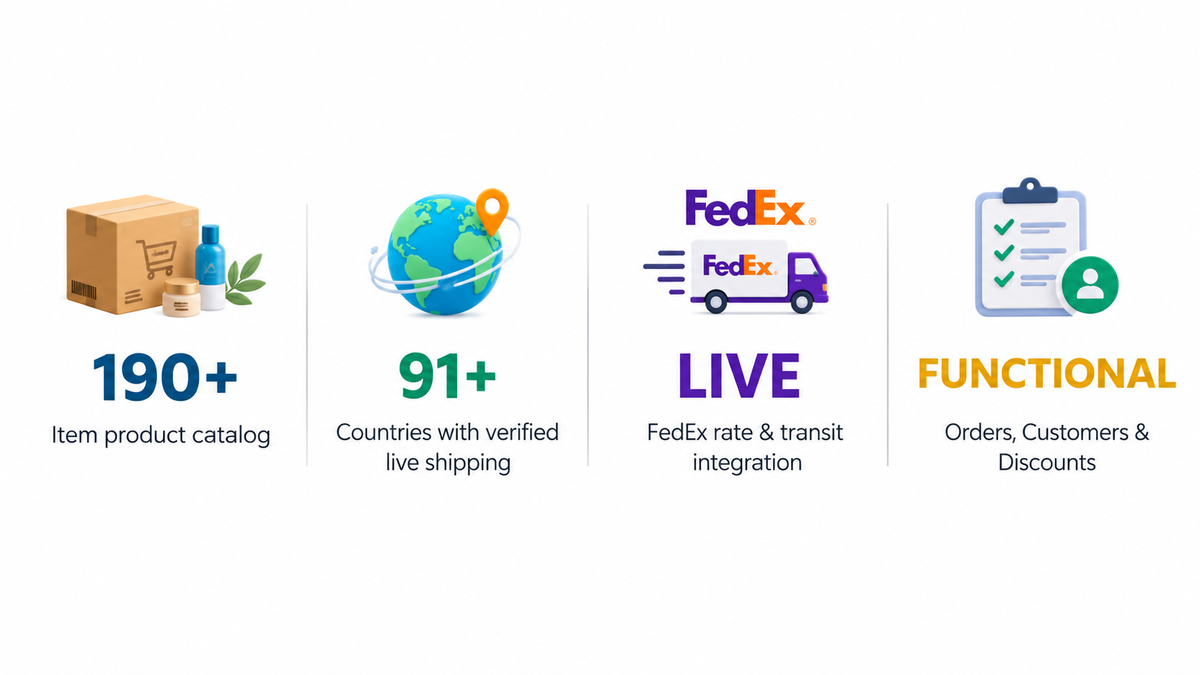
- The website grew from roughly 9 legacy pages to a 70+ page platform without losing design or navigational coherence.
- Live carrier-quoted shipping replaced static shipping-rate logic.
- Checkout shipping data integrity was corrected and destination verification was introduced.
- Cart and shipping selections persist across refreshes and reopened tabs.
- Key administrative workflows were restored and consolidated across products, orders, customers, discounts, quote requests, vendors, partners and content management.
- A role-based staff permission system was introduced, enabling scoped sub-admin access with attributable changes.
- Customer order history and saved-address functionality became available.
- A client-requested request-for-quote pathway for heavy enterprise hardware was built and refined into production.
Business Value
For a B2B business operating across complex product, service and international commerce workflows, the quality of the digital platform directly affects customer confidence and operational efficiency.
Arismeta's work strengthened the systems behind the storefront while improving the customer journey. The result is a more reliable foundation for international commerce, internal operations and future digital growth.
Built for the Next Stage of Digital Commerce
With the platform foundation strengthened, Metamorfs is better positioned to extend its digital commerce and enterprise experience through future enhancements across content, customer journeys, analytics, conversion and global operations.
Recommended Visual Proof for Publication
- Legacy website homepage
- Current Metamorfs homepage
- Service architecture: legacy categories → current enterprise pillars
- Product catalogue
- Product detail page
- Cart and checkout
- Live FedEx shipping result
- Admin dashboard
- Customer account: My Orders and Addresses
- Before / after transformation graphic
Build a Digital Platform That Works as Hard as Your Business
Arismeta combines strategy, design and engineering to build digital platforms for complex business environments.
Let's build your next digital platform